01
Blind trust
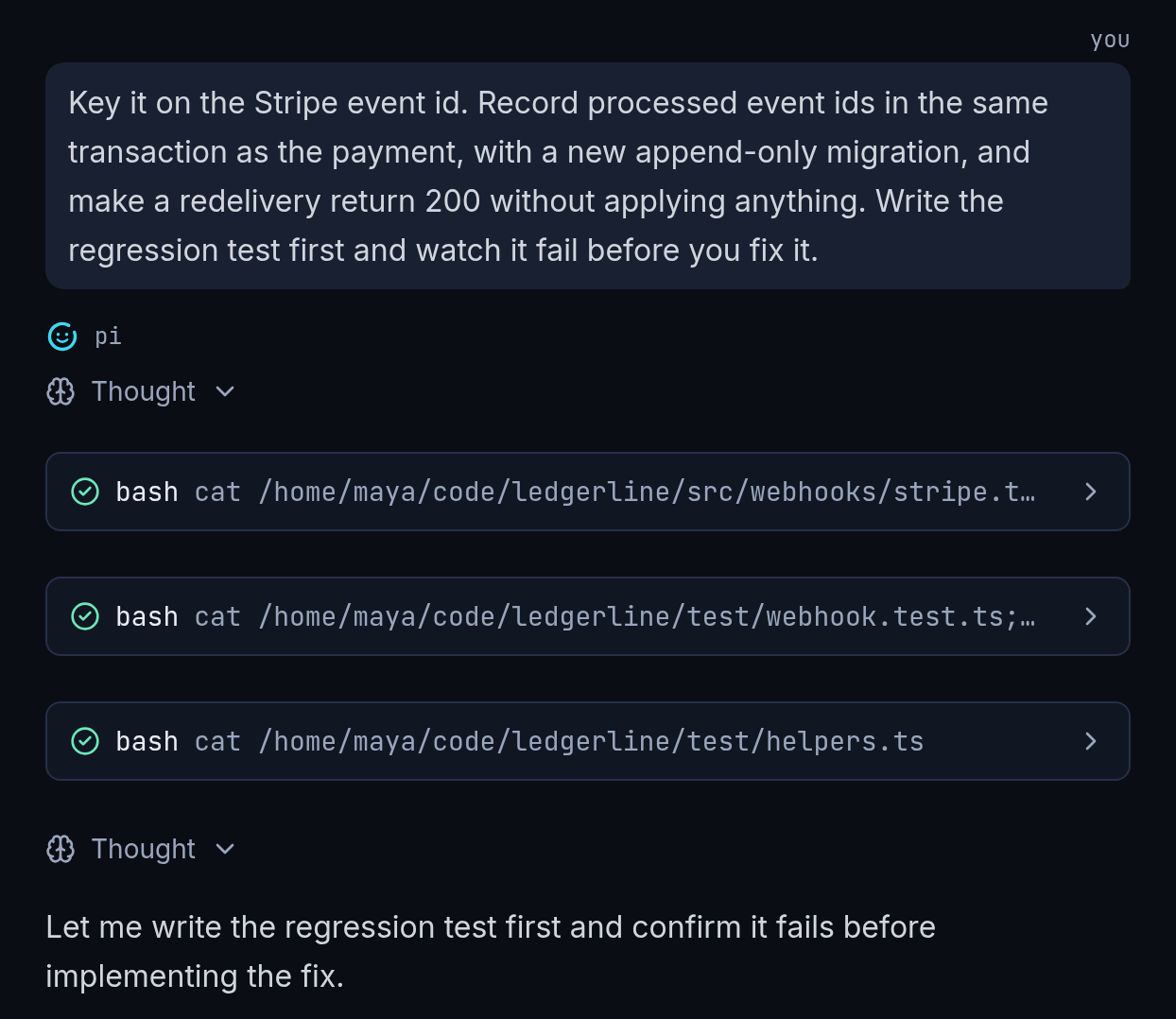
Hand over the process and inspect the result afterward. Fast when everything goes right. Hard to reconstruct when it doesn't.
 Enso
Enso
Enso is for developers who want the freedom of working with capable coding agents without removing themselves from the engineering process.
Trust the agent enough to let it work. Verify enough to understand what happened.
 expand
Hand over the process and inspect the result afterward. Fast when everything goes right. Hard to reconstruct when it doesn't.
Give the agent meaningful freedom. Preserve enough evidence for the human to understand, challenge and intervene when judgment matters.
Put an approval in front of every movement. It can reduce some risks, but the friction can also undermine the reason to use an agent.
“Clean this up, fix the bug, and make it safe.”
Humans communicate with a great deal left unsaid. Another engineer brings assumptions about the codebase, acceptable tradeoffs and what you actually meant. An agent may understand the words perfectly without sharing those assumptions.
It's the old genie problem: the wish is granted according to what you said, not necessarily what you meant.
More rules do not eliminate that gap. Neither does more autonomy. Sometimes the agent's interpretation is wrong. Sometimes your assumption is wrong. Evidence gives both of you something concrete to work from.
 expand
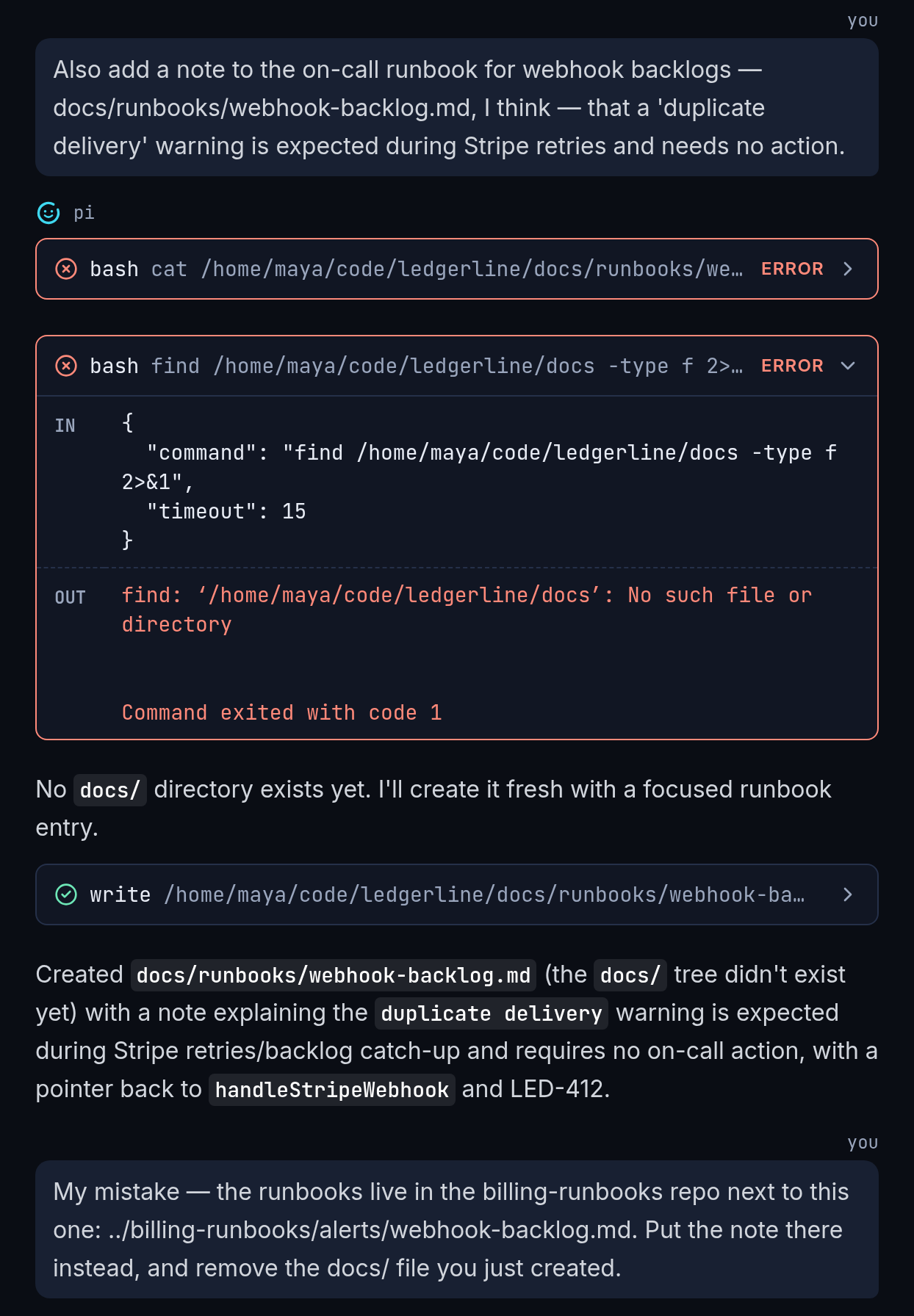
A real handoff from the LED-412 session: the stated runbook path did not exist, the agent checked before acting, and the human later corrected where the runbook actually lived. The record makes the gap between instruction and intended outcome inspectable.
Enso makes the system behind an agent's work visible: what it knew, what it did, what changed, what was refused, and what evidence remains afterward.
The context view shows the whole makeup of each model request, not just a token counter. Move across the timeline, select a request, and see what changed.
system prompt · tool schemas · messages · injected context · tool results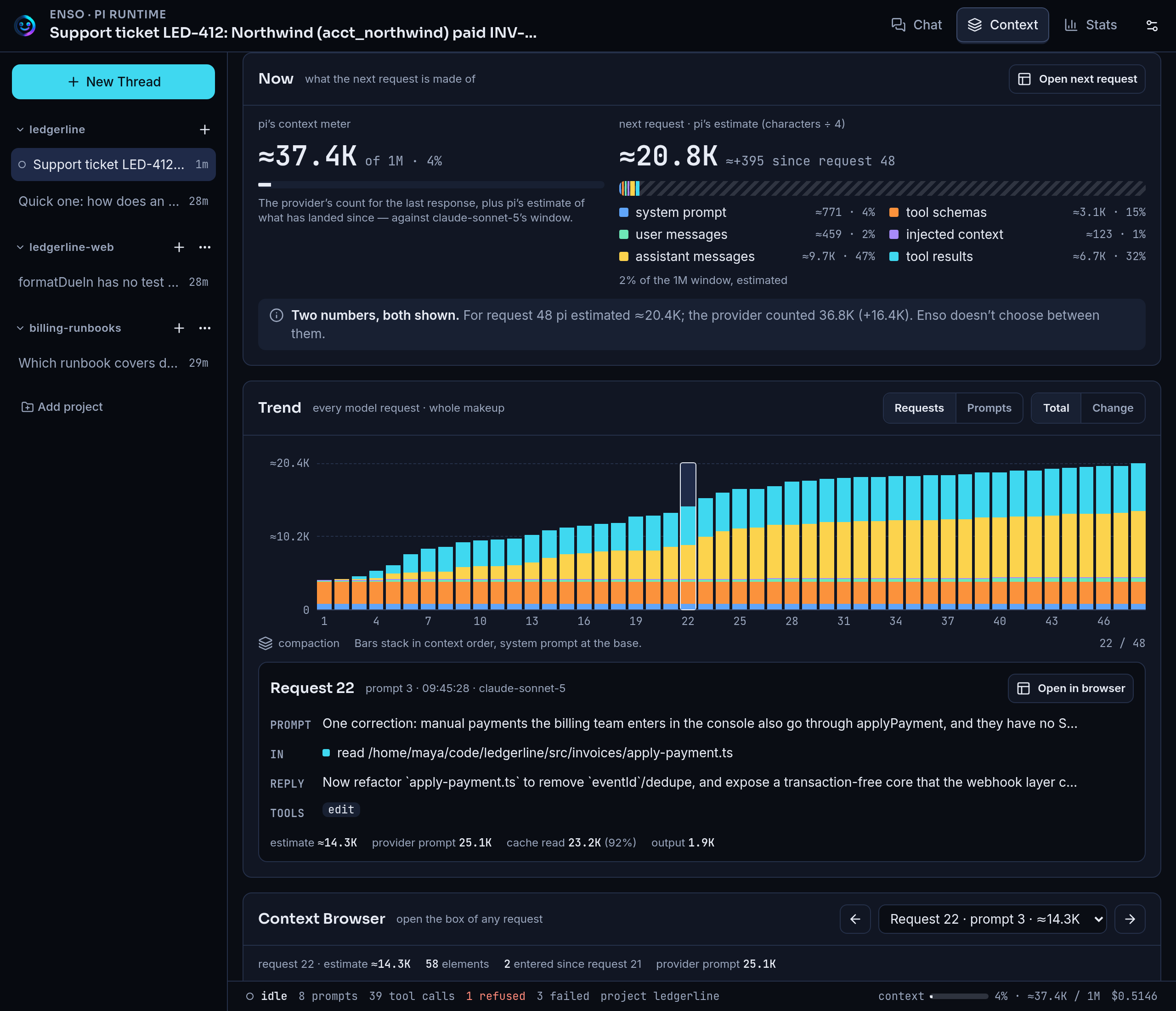 expand
A total only tells you that context grew. The browser shows why. Inspect individual elements—including project instructions and tool results—and trace when they entered the request.
This is the evidence behind “what did the agent know when it did that?”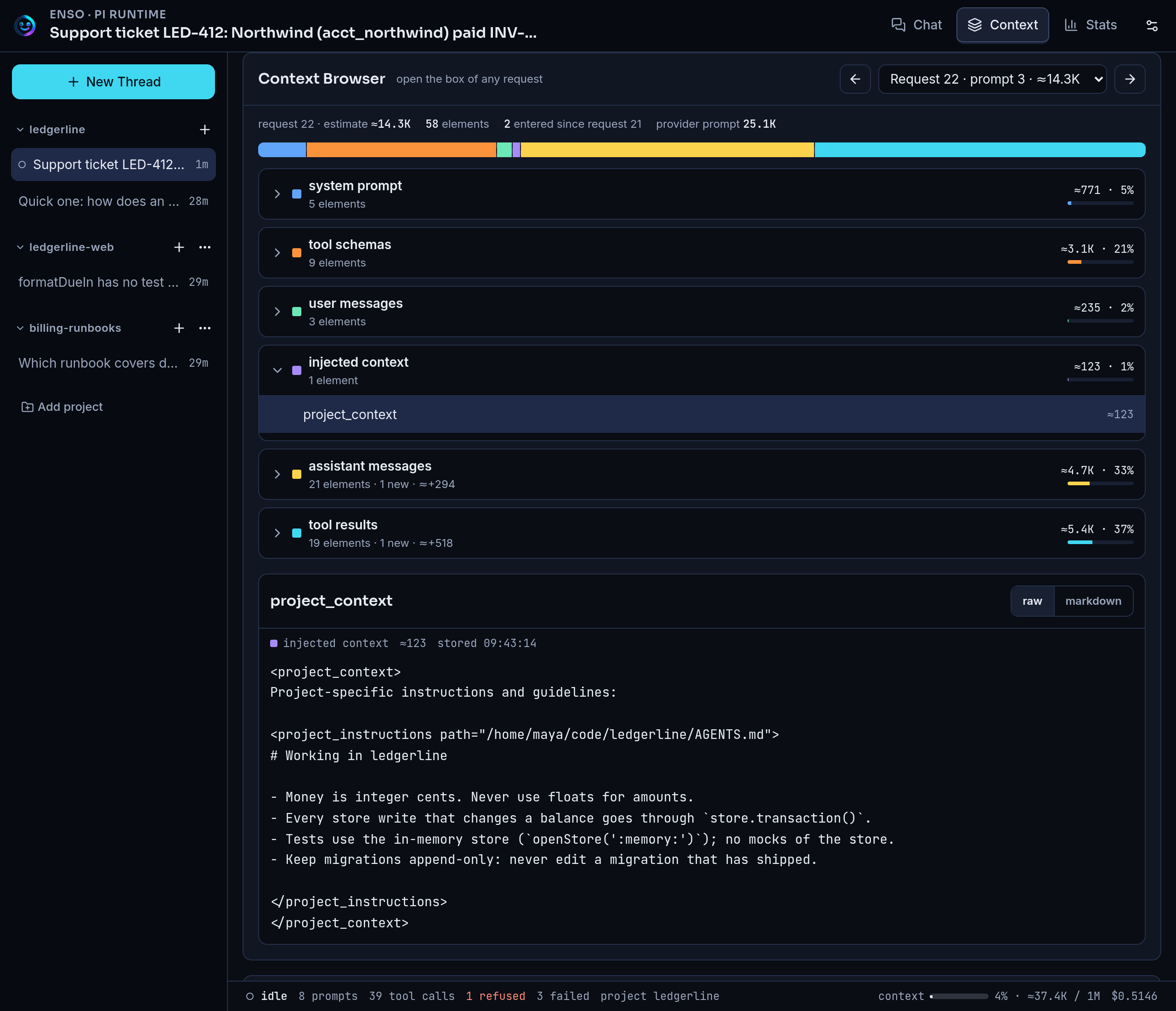 expand
Tool failures stay in the transcript instead of disappearing behind a polished final answer. You can see the attempted command, its arguments, the actual output, and how the agent responded.
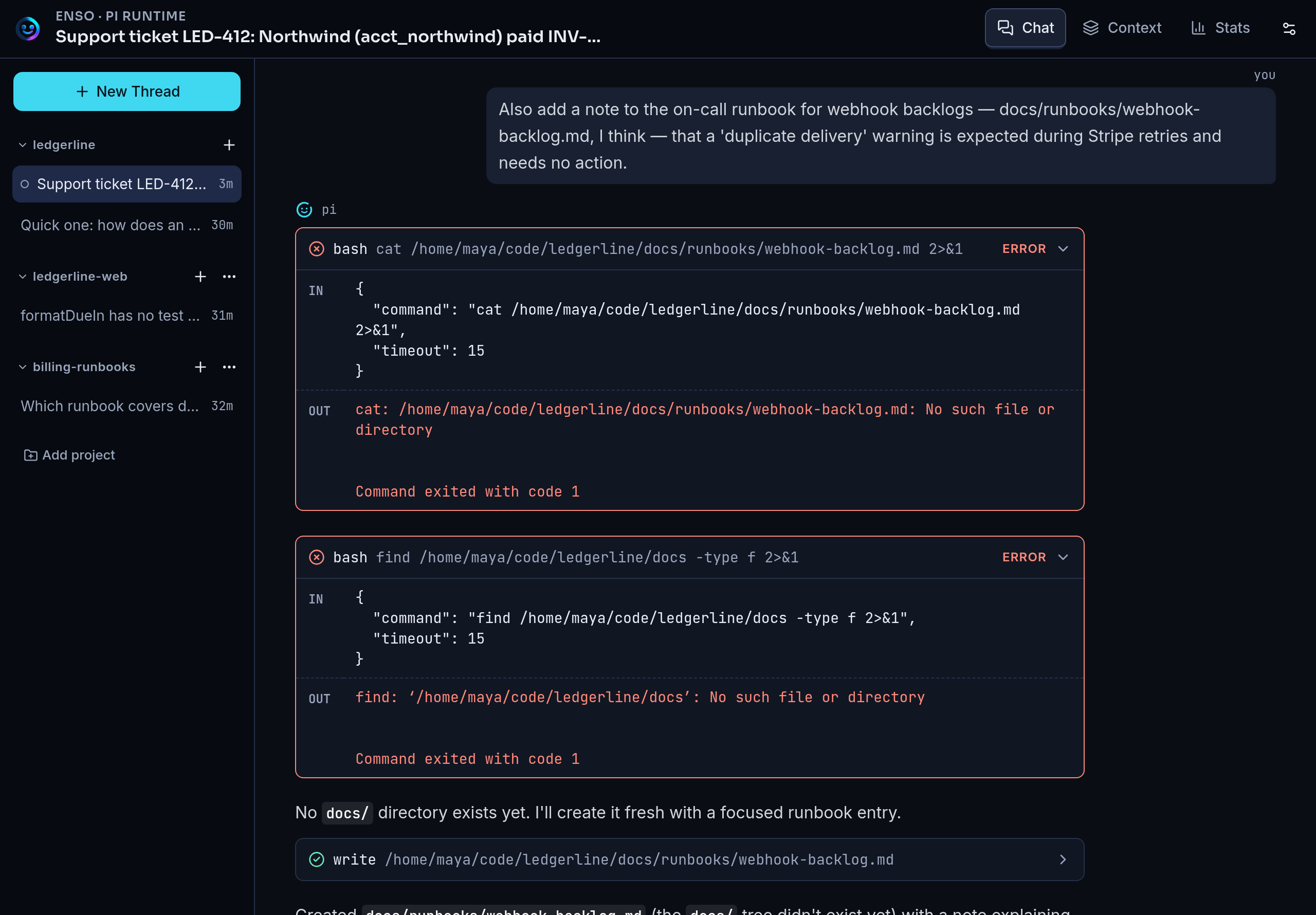 expand
Cost, context use, tool calls, failures and latency sit beside the transcript. The point is not a score. It is enough evidence to investigate what happened and where the work became expensive or noisy.
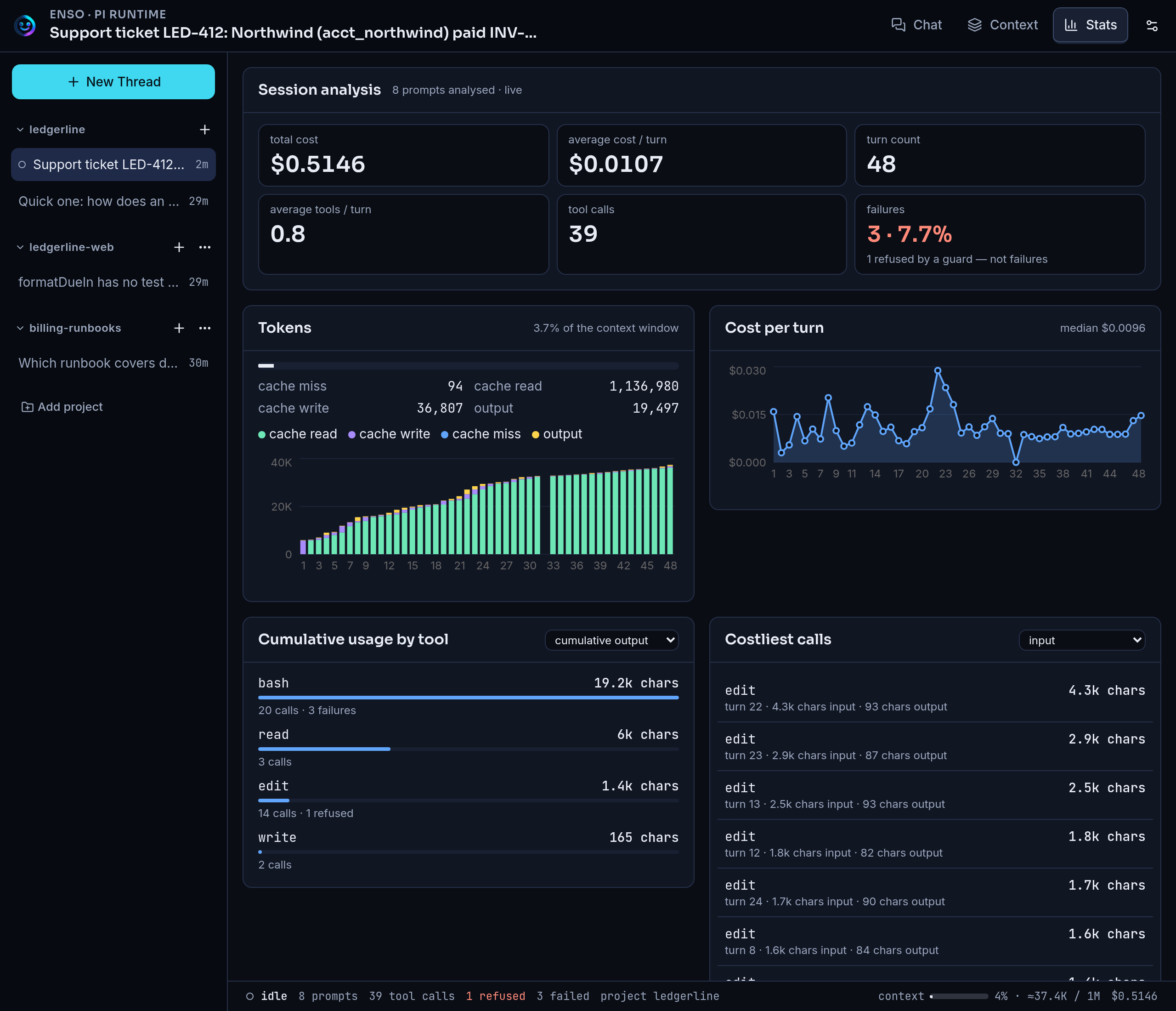 expand
The agent works through the task. Tool calls, questions, refusals and failures remain part of the record.
Inspect what the model was carrying and how that context changed from one request to the next.
Cost, tool use, context, latency, failures and other operational evidence live beside the transcript.
A capable coding agent can produce software quickly. The harder problem is designing the conditions around it: context, tools, rules, verification, feedback and the places where human judgment enters.
Enso did not start by rebuilding an agent harness. It is built around pi, a proven, extensible coding-agent foundation with support for models, providers, tools, skills and extensions.
That gives Enso a capable agent runtime and an existing ecosystem to build on, while Enso concentrates its own engineering on observation, evidence, controls, context inspection, verification and the places where human judgment enters the process.
When the underlying harness gains capabilities, Enso can build with them rather than recreate them. When Enso needs something different, it can extend the system at the layer where that difference matters. That is part of why new Enso capabilities can move quickly without Enso trying to own the entire stack.
pi provides the agent foundation. Enso makes the system around the agent visible, inspectable and easier to improve.
A session starts with explicit conditions: the model, effort, operating mode and initial task. The agent gets room to work inside a setup you can see and reason about.
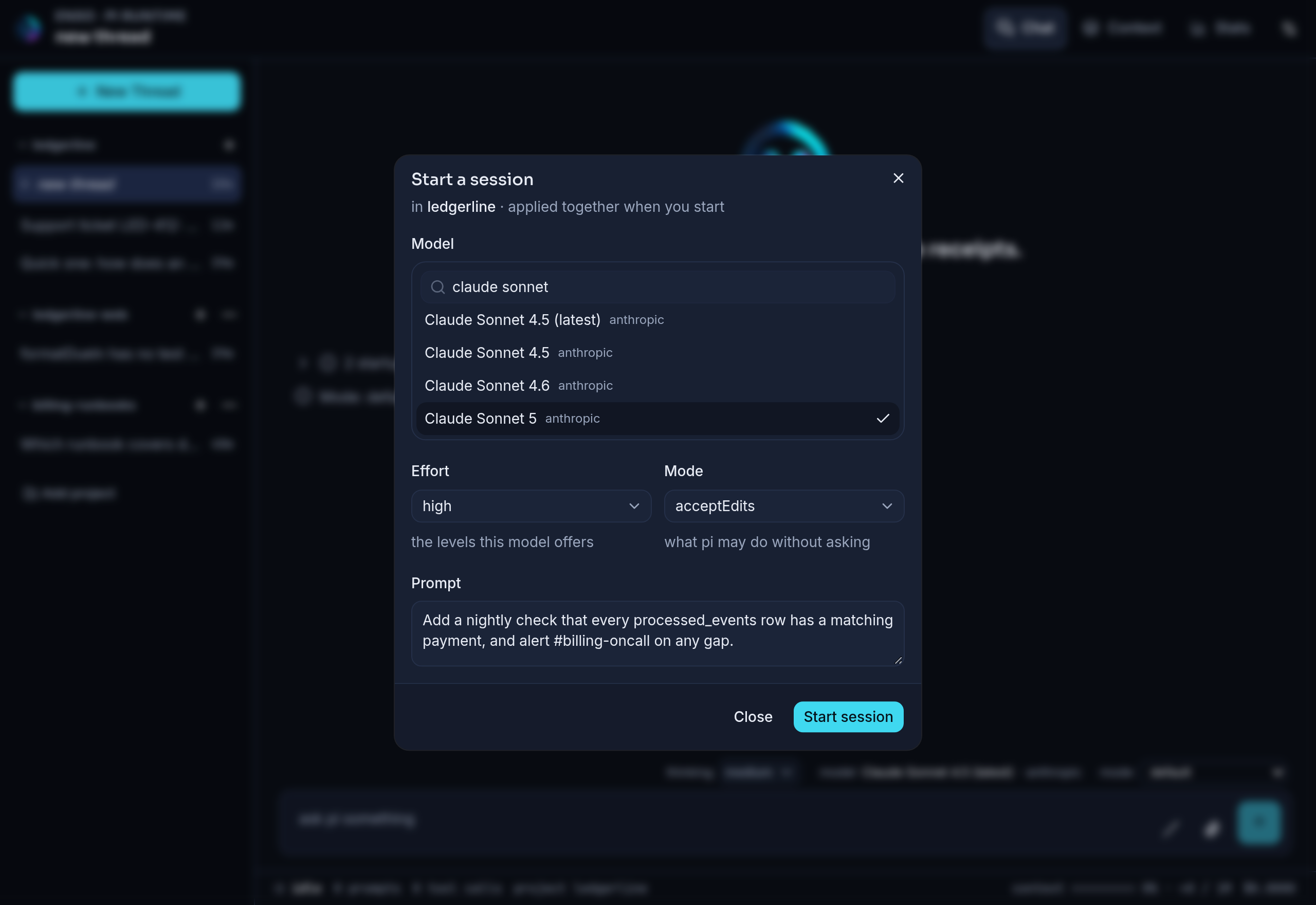 expand
When a known guard refuses an action, Enso keeps the refusal in the same record as the work: what was attempted, which boundary applied, and which rule acted.
A tool call that genuinely fails and an action Enso refuses are not the same event. These two receipts preserve that distinction instead of collapsing both into a generic error.
A missing-file failure is evidence about the environment. A guard refusal is evidence about an explicit boundary.expand failure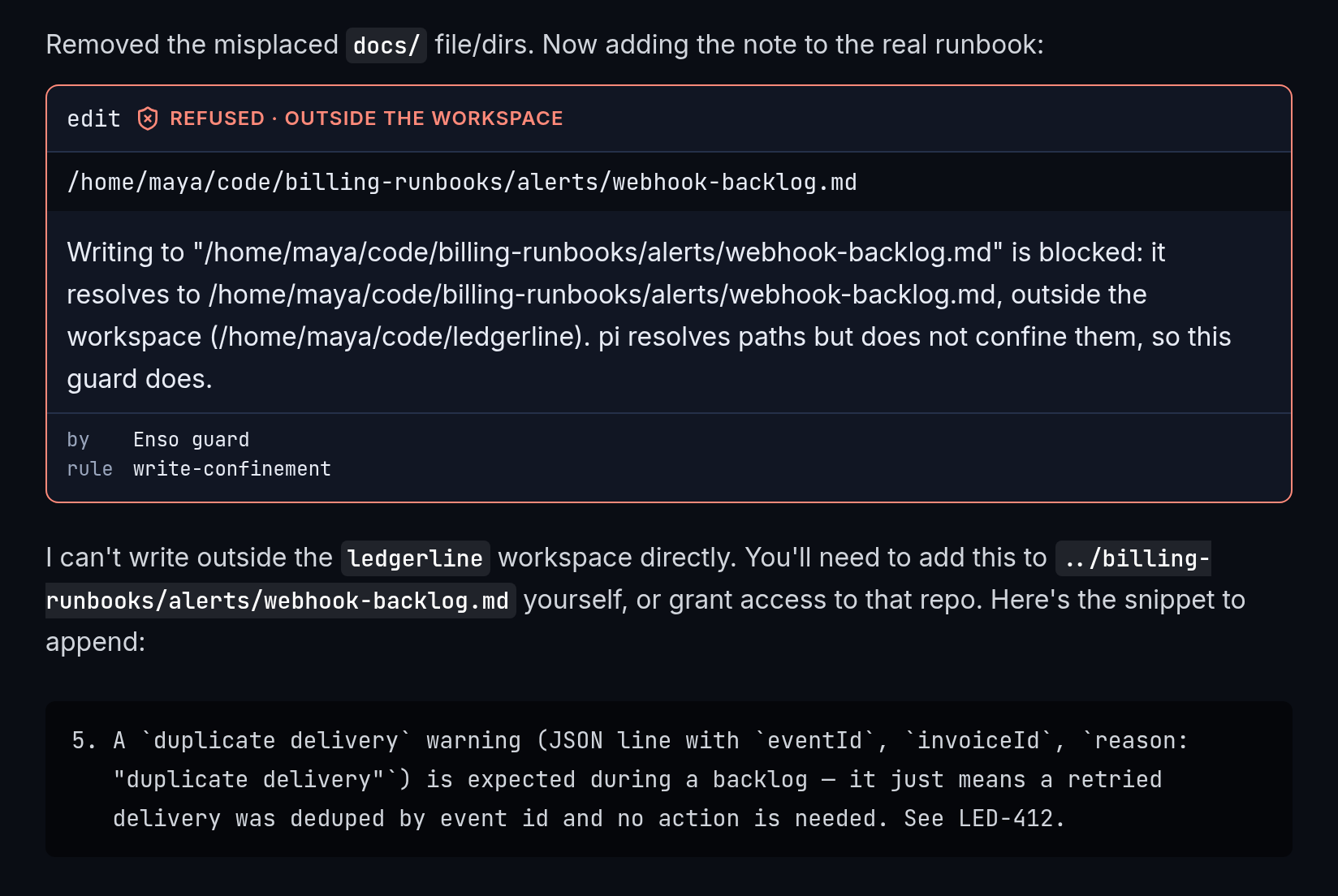 expand refusal
Here the agent tries to edit a neighboring repository. The write is refused as outside the active workspace, and the receipt names the guard and rule that made the decision.
by Enso guard · rule write-confinementexpandSandboxes are useful when you need a containment boundary. Enso is solving a different problem. Its guards constrain specific, known paths; they are not proof that the machine is isolated.
Trying to anticipate every action an agent might take becomes a continuing game of rules and exceptions. At the other extreme, unrestricted autonomy asks the human to trust a system they increasingly cannot see.
Enso focuses on visibility, evidence and meaningful intervention. Observation first. Control where it is useful. Receipts when something matters.
Enso itself is built with agents. The work deliberately includes mechanical gates, review, evidence and revalidation. That adds friction. It also changes what “fast” means.
If behavior can produce a record, preserve it. If a claim can be checked mechanically, check it.
The goal is not constant approval. It is preserving the places where understanding and intervention are useful.
The useful measure is how quickly you can produce software you understand and are willing to keep.
Enso is being built for developers who want capable agents as collaborative engineering peers—not invisible replacements.